


Table of Contents
SMS marketing is one of the most direct and effective ways to reach your audience – with a 7.5X better response rate than email and open rates that regularly exceed 90%.
In a world where people are constantly on their phones, SMS marketing cuts through the noise that buries most emails and social posts. It’s immediate, personal, and concise – and whether you’re a nonprofit trying to mobilize donors, a political campaign driving voters to the polls, or a small business running a flash sale, it delivers results that other channels simply can’t match.
This guide covers everything you need to know to get started and grow:
- How to start SMS marketing
- How to choose the right texting number
- Building your list with SMS marketing
- The right texting tool to use for one-way and two-way communication
- Use cases for SMS marketing
- Text message regulations you need to know
- Best practices for using SMS
- What to look for in an SMS marketing tool
How do I start SMS marketing?
Getting started with SMS marketing essentially comprises three parts:
Choosing your number:You must choose between a short code and a 10-digit long code(10DLC) that people will see as the Sender ID.
Building your list:Managing opt-ins to your list and running your SMS marketing program.
Texting your list: Different ways of using SMS at your organization.
Let’s start with the number you’re going to use.
Different types of SMS marketing campaigns
When it comes to SMS marketing, not all messages are created equal. Depending on what you’re trying to achieve, your campaigns will usually fall into one of three categories:
1. Promotional SMS campaigns
These are the go-tos for grabbing attention and driving quick action. Think flash sales, limited-time discounts, or announcements about a new product launch. They’re all about creating excitement and getting people to click, shop, or sign up quickly.
2. Transactional SMS campaigns
These messages are more functional but just as important. They keep customers in the loop with best timely updates, like order confirmations, shipping alerts, appointment reminders, or password resets. Anything that’s triggered by an action a customer takes.
3. Conversational SMS campaigns
This is where things get a little more personal. Conversational campaigns are about two-way communication – answering questions, collecting feedback, or chatting. Whether it’s a real person or an automated system behind the messages, the goal is to build trust and keep the conversation going.
Each type plays its role in a well-rounded SMS marketing strategy. Together, they help you reach people and connect with them.
Read Also: SMS Marketing Tactics Every Marketer Needs Now
Choosing the Right Texting Number – Short Code vs. Long Code vs. 10DLC
There are three number types available for SMS marketing today: dedicated short codes, long codes, and registered 10DLCs.
| Shared short codes – once a popular low-cost option – have been fully sunset by US carriers and are no longer a viable path for any organization. Any messages sent via shared short codes are now automatically flagged as spam and blocked. They are not covered here because they are not an option. Read Also: Shared Shortcode Is Going Away: Switch Now |
Here’s how the three current options compare.
What is a short code?
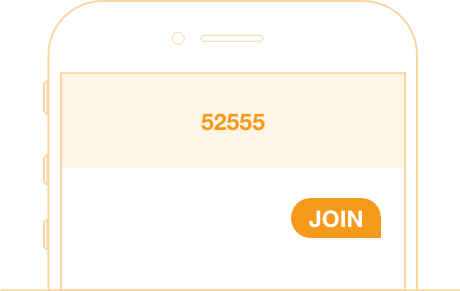
Example of a short code
A short code is a 5- or 6-digit phone number used by businesses, nonprofits, and political campaigns to send text messages at scale. Unlike a standard 10-digit long code, a short code can handle a high volume of messages with fewer carrier restrictions.
Advantages of using a short code:
- Brand recollection: Short codes can be as memorable as a website or social media handle. Example: 62262, which spells out OBAMA on the keypad.
- Quick delivery: Built for high-volume sending, making them ideal for time-sensitive or large-scale campaigns.
- Carrier trust: Dedicated short codes go through a formal vetting process and carry strong deliverability.
Disadvantages include:
- Longer time to implement: They take a couple of weeks to go through a review process.
- Impersonal: Since short codes are meant for one-way communication and automated interactions, they don’t allow for personal conversations.
- Cost: A dedicated short code can cost anywhere from $500 to $1,000 a month.
What is a dedicated short code in SMS marketing?
A dedicated short code is an exclusive numeric sequence used in SMS marketing, exclusively assigned to one business. It grants complete control over associated keywords, enabling unique interactions with customers. Customer experience and loyalty is crucial in SMS marketing, and a platform offering excellent support ensures you have assistance when needed.
With a dedicated short code, a business controls all the keywords they want to use with the short code.
With a dedicated short code, you can generate unlimited keywords without paying extra to join your list, donate to your cause, sign up to volunteer or any other requirement.
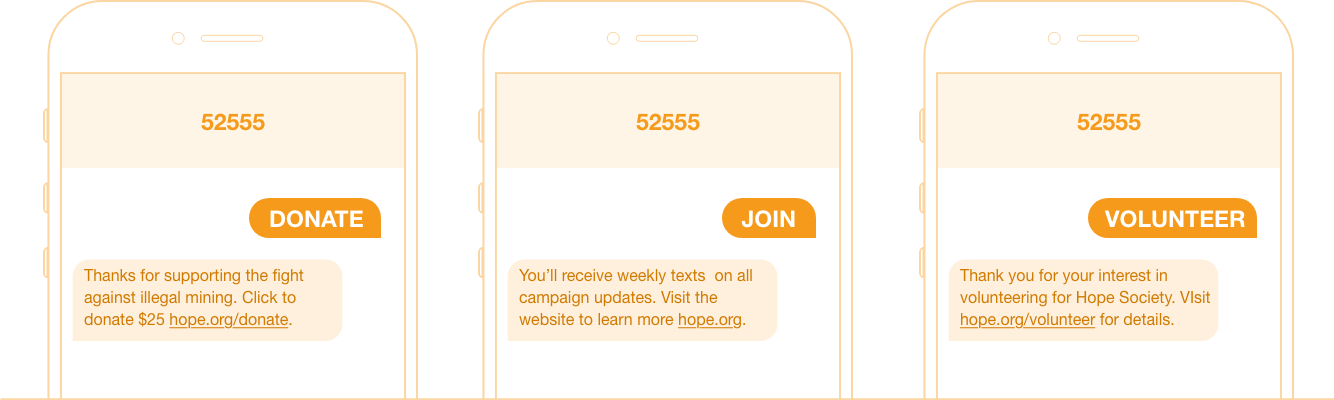
Example of a dedicated short code
While a dedicated short code is expensive, it offers businesses the most control regarding branding and message delivery.
Advantages of using a dedicated short code include:
- Unlimited keywords – A dedicated short code gives you control over the keywords you want to use.
- Higher send limit – You can send texts in large volumes.
Disadvantages include:
- They are expensive – A dedicated short code can cost anywhere from $500 to $1000 a month.
What is a long code in SMS marketing?
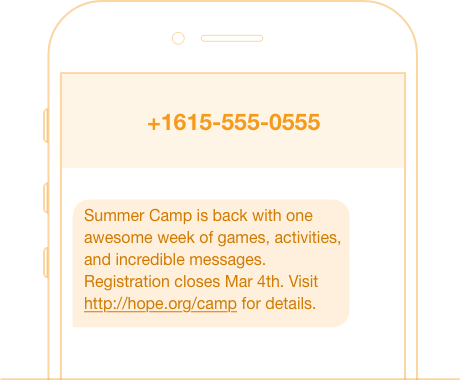
Example of a long code
A long code is a standard 10-digit phone number – the same format as a regular cell phone number. Long codes are inexpensive to rent (around $2 a month) and are well-suited for two-way conversations and building a local presence.
Businesses usually rent multiple long codes based on the area codes of the contacts on their list. That way, each contact sees a familiar local sender ID when they receive the text, which improves open rates and trust.
Advantages include:
- Quick implementation: Can be rented and set up in seconds.
- Personal: Establishes a local presence with a familiar-looking number.
- Two-way conversations: Long codes support back-and-forth dialogue, making them ideal for peer-to-peer texting.
- People can call back: You can route incoming calls from a long code to your main business line.
- Unlimited keywords: No restrictions on the keywords you use.
- Cost-effective: Far less expensive than a dedicated short code..
Disadvantages include:
- Must be registered as 10DLC: As of February 1, 2025, all long codes used for business texting in the US must be registered. Unregistered long codes are blocked by carriers. A bare long code is not a compliant option.
- Lower throughput than short codes: Even with 10DLC registration, volume limits are lower than a dedicated short code.
- Less memorable: A 10-digit number is harder for contacts to remember or recognize compared to a short code.
What is a 10DLC — and why is it now mandatory?
A 10DLC is a registered long code – and as of February 1, 2025, it is the mandatory standard for all business text messaging sent via 10-digit numbers in the US. This is not optional. Unregistered long codes are blocked by all major carriers, meaning your messages simply will not be delivered.
10DLC registration involves two steps: registering your brand (your organization’s legal entity) and registering each individual campaign (your specific messaging use case). Both are submitted to The Campaign Registry (TCR), the central body that vets and approves A2P messaging in the US.
What you’ll need to register:
- Your legal organization name and EIN (must match IRS records exactly)
- A description of your messaging use case (e.g., fundraising, event reminders, GOTV)
- Sample messages for each campaign type
- Documentation showing how you collect opt-ins
The registration process typically takes one to three weeks. Budget for this timeline before launching any new SMS marketing program.
Advantages of 10DLC:
- Compliance: The only compliant way to send business texts via long code in the US.
- Improved deliverability: Pre-approved by carriers, so messages are far less likely to be filtered as spam.
- Higher throughput: Up to 180 messages per second with proper registration, compared to the old one-message-per-second limit on unregistered numbers.
- Cost-effective: Registration fees are modest compared to the cost of a dedicated short code.
- Supports two-way messaging: Retains all the conversational advantages of a standard long code.
Disadvantages of 10DLC:
- Registration takes time: The process is more involved than simply renting a number.
- Per-campaign fees: Each campaign use case incurs a one-time registration fee.
- US domestic only: Not designed for international messaging.
So, what’s the verdict?
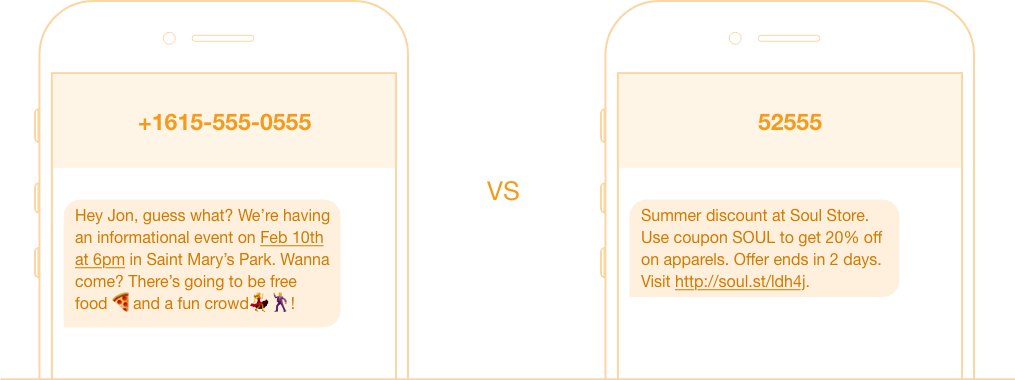
Long code vs. short code
If you want to broadcast promotional SMS to your audience, we recommend using a short code. Go for a shared short code if you are starting with SMS marketing. Once you build traction and see a definite impact around SMS marketing, move to a dedicated short code.
If you want to cut down on costs, send personalized sms, and even engage people in conversations, use a long code. In case are texting a large group, rent a group of numbers instead of using a single long code to improve your deliverability.
If you send over 3000 messages daily and use more than five long codes, transitioning to a 10DLC is crucial to prevent message filtering. Unlike unregistered long codes, 10DLCs offer a significantly higher throughput, allowing up to 180 messages per second with pre-verification of numbers.
This is a substantial improvement compared to the limited throughput of one message per second with standard long codes.
Building your list with SMS marketing
Once you have a number in place, the next step is to decide on a keyword. Subscribers text the keyword to your number to sign up for your SMS marketing list.
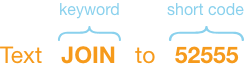
Example of a keyword and a short code
Note: If you’re using a shared short code, you will rent a specific keyword. In this scenario, you must decide on the keyword before renting the number.
With the keyword and number ready, you can create your SMS campaign and set up automated text responses that will go out to people who join your list.
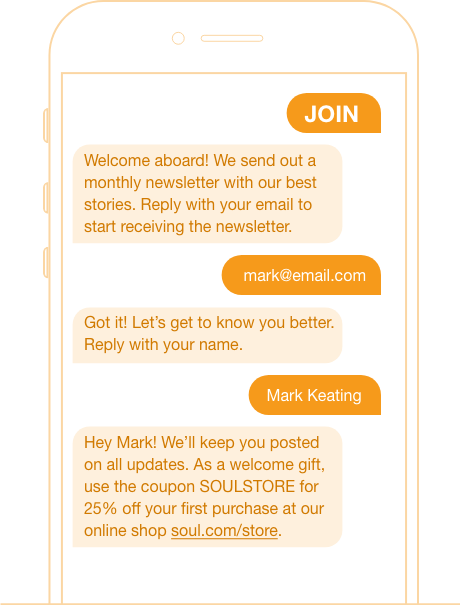
Let’s say you chose the keyword JOIN and the short code 52555.
Depending on your goals, you can choose to send a thank you message immediately after the opt-in or set up automatic interactions in your text messaging service to capture additional details.
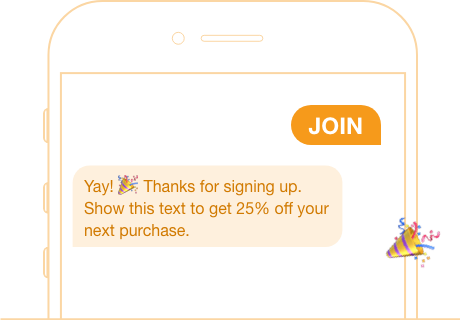
Example of building your list with SMS marketing
If most of your communication will be over text messages, you want to make it as easy as possible for people to opt in. In that case, a simple thank you message does the trick.
Example of data collection with SMS marketing
However, if you intend to communicate with subscribers over other marketing channels, go ahead and ask for more details.
Your text messaging service takes this information and builds out a profile for each subscriber. Most services come with integrations that sync this information instantly with your CRM, so you don’t have to worry about moving data back and forth using spreadsheets.
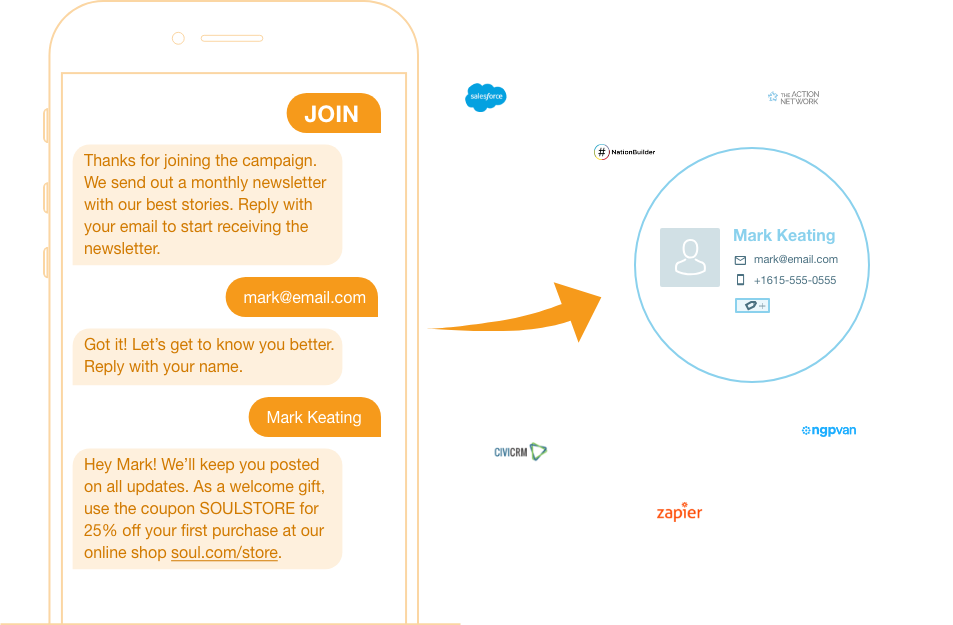
Syncing information from your text messaging platform to CRM
If you can’t find integration with your CRM, it’s easy to use a service like Zapier to send contacts from your text message service directly to your CRM.
Promote your keyword and number
The more people join your list, the higher the impact of your SMS marketing campaigns. Promote your keyword and number across every channel available:
- Social media
- Direct mail
- Email and email signature
- Website and blogs
- Yard signs and flyers
- Business cards
- Any other marketing channels where people see your messaging
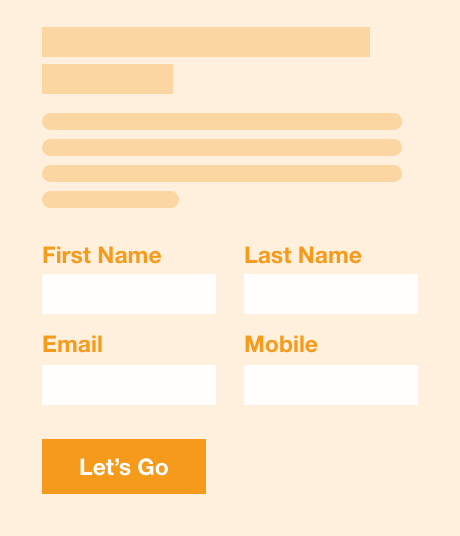
Example of a website form collecting mobile numbers for SMS marketing
If you have forms on your website, add a field to collect mobile numbers with a checkbox explicitly mentioning that you will send text messages. It’s excellent practice to let people know why you’re asking for their phone numbers and what kind of messages they can expect.
Read Also: Here is how to send automated texts in 2025.
Communicating with an audience over SMS marketing messages
You can use text messages to communicate with your audience in two ways: one-sided communication or two-sided communication.
Using text messages for one-sided communication, (mass texting)
One-sided communication involves
- Promotional messages
- Reminders & alerts
- Event invitations
- Announcements
- Holiday greetings
- Appreciation
- Feedback requests
… and other updates you want to communicate to people.
All you need to do is choose the list you want to text, craft your message (including any links), and schedule messages
a time you want the text to go out – a lot like an email service.
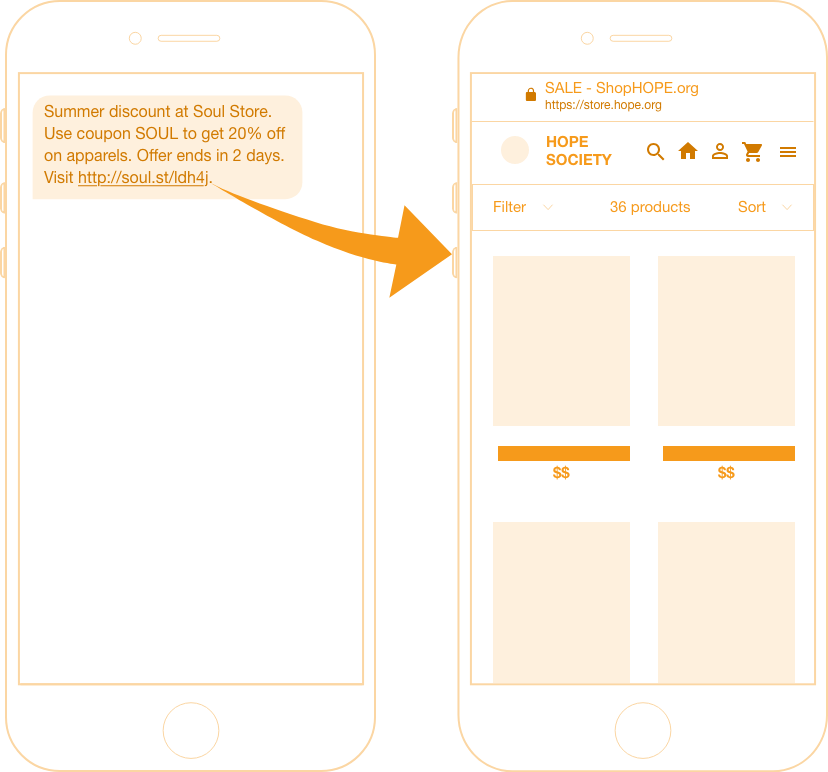
Link in text directing people to a mobile-optimized landing page.
Make sure your links direct people to a mobile-optimized landing page.
| Pro tip: Instead of keeping things one-sided, mix things up occasionally by sending surveys, polls, and quizzes. These tactics can improve engagement in your SMS marketing campaigns and give you valuable data about your audience. |
Read Also: 12 ideas for using text messages at your nonprofit
Using text messages for two-sided communication
On most occasions, your texts are part of an automated campaign that is scheduled to go out when:
- Someone opts into your list
- When you want to broadcast information to a group of people.
However, there are instances where you will want to engage your audience in a conversation. Especially if you are trying to get them to take action, like attending an event, donating to a cause, or casting their vote.
That’s where peer-to-peer texting comes in.
How does it work?
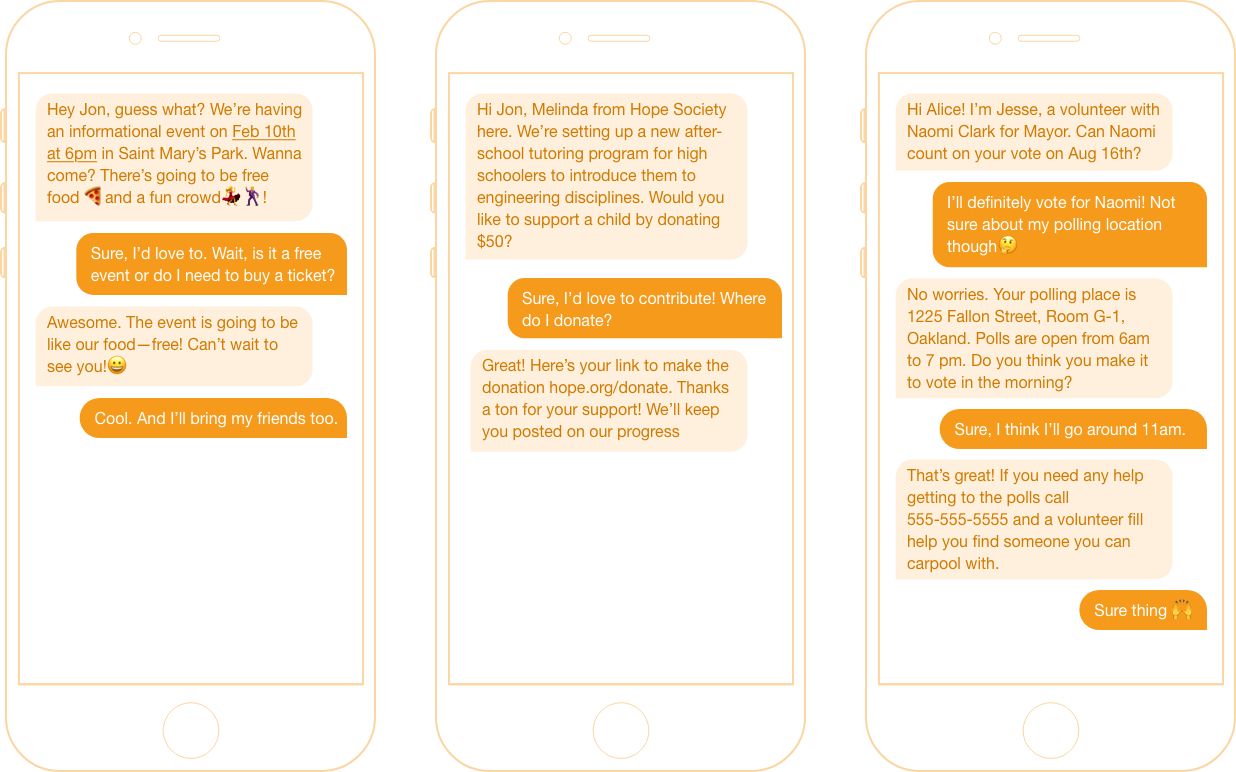
Examples of peer-to-peer texting conversations for event invites, fundraising, and Get Out The Vote
Peer-to-peer texting lets organizations have one-to-one conversations with people at scale with the help of agents. A single agent can have around 1000 conversations in the span of an hour.
While a mass texting campaign is meant to get information in front of an audience, peer-to-peer texts are intended to get people to chat with you to take a specific action.
Compare these two approaches to the same event invitation:
Broadcast message:
| “Informational event next week on the 10th of February at 6 pm in Saint Mary’s Park. Reply YES to RSVP.” |
Peer-to-peer conversation:
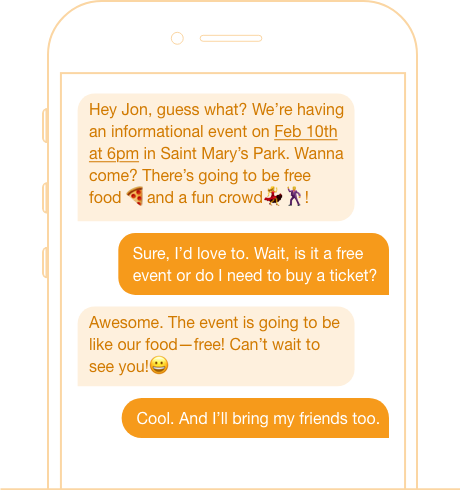
| “Hey Jon, guess what? We’re having an informational event next week on the 10th of February at 6 pm in Saint Mary’s Park. Wanna come? There’s going to be free food and a fun crowd!” “Sure, I’d love to. Wait, is it a free event, or do I need to buy a ticket?” “Awesome. The event is going to be like our food – free! Can’t wait to see you! 😀” “Cool. And I’m bringing my friends too.” “Perfect 🙌 See you there.” |
Which person do you think is more likely to attend?
That’s right, the second one.
The same goes for getting a supporter to donate to your cause or getting a voter to the polls on election day. A personal conversation is far more effective when you want to initiate an action from your audience. This is why conversational SMS marketing works especially well for fundraising, volunteer recruitment, and GOTV.
Use cases for SMS marketing (with practical examples)
Here are SMS marketing examples of how text messaging helps organizations connect with the people they care about:
Nurturing prospects
With how easy it is to send a text message, SMS marketing is a formidable tool to help you stay in touch with your prospects. Whether you’re promoting a limited-time offer, announcing a flash sale, sending a volunteer sign-up link, or running a donation drive, SMS marketing provides the ideal platform for nudging people toward action.
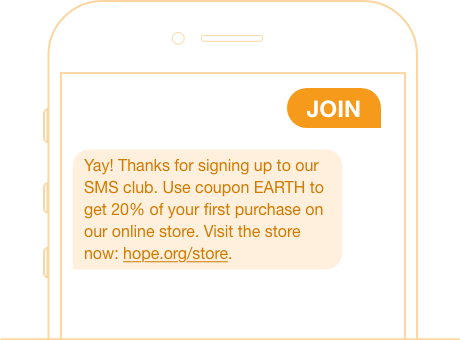
Offering an incentive on opt-in
Offer an incentive.
Encourage people to make a purchase by offering an incentive if they sign up to receive SMS updates.
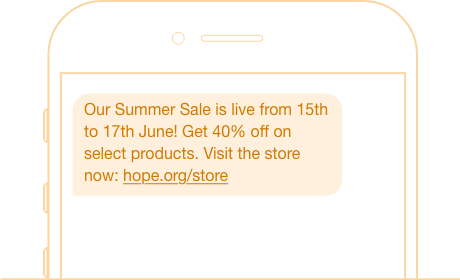
Text broadcast announcing a sale
Promote a sale.
Send out a quick broadcast text to inform people about an upcoming events like sale or share exciting news through engaging promotional messages and boost your SMS marketing efforts.
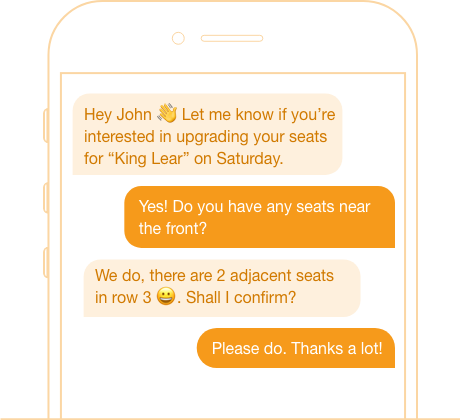
Selling a ticket to an event through SMS marketing
Have a live agent walk prospects through the process of booking a ticket at a show.
Getting people to your events through SMS marketing
Getting people to attend an event through impersonal broadcasts rarely works. The right mix of personal communication and automated messages, however, can work wonders.
Nudging contacts to attend an event through SMS marketing
Invite people to your event.
Inform people about your event and nudge them to attend over a personal conversation.
SMS reminder for an event
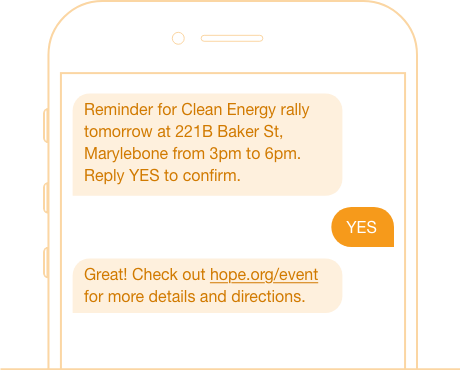
Send an automated reminder.
Send an SMS reminder on the day of your event, just in case!
Thank attendees and ask for feedback.
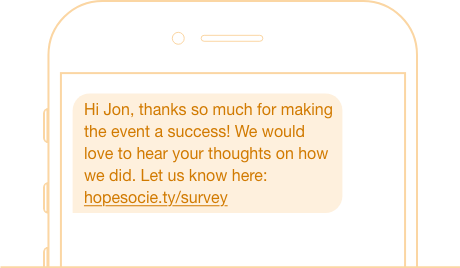
Thank your attendees for coming and take the opportunity to insert a link to a quick survey, asking for feedback on the event.
| Check out our extensive guide on using texting for events. |
Volunteer engagement
Volunteers are the lifeblood of your organization. Recruiting and keeping them up to speed on your organization or event is critical for smooth operation.
Recruiting volunteers via SMS
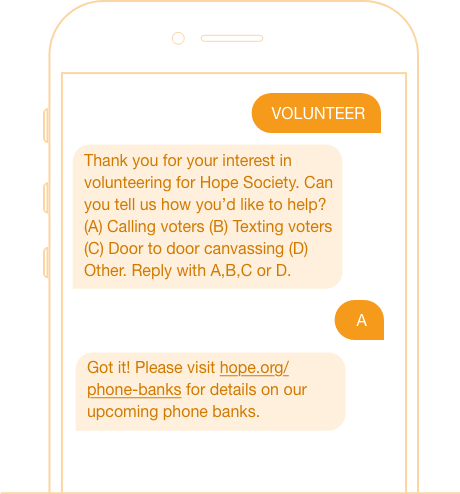
Let interested supporters sign up to volunteer.
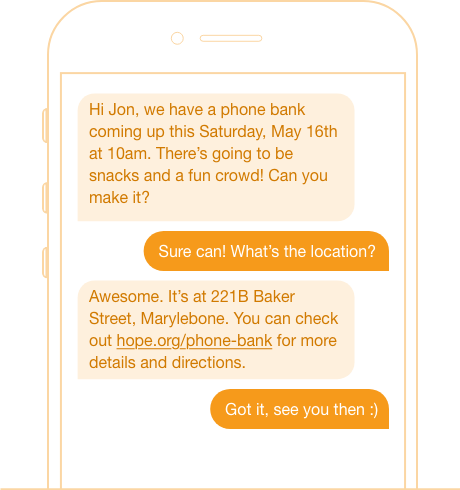
Communicating volunteer opportunities via SMS
Discuss responsibilities.
Inform sign-ups about upcoming events like volunteer opportunities.
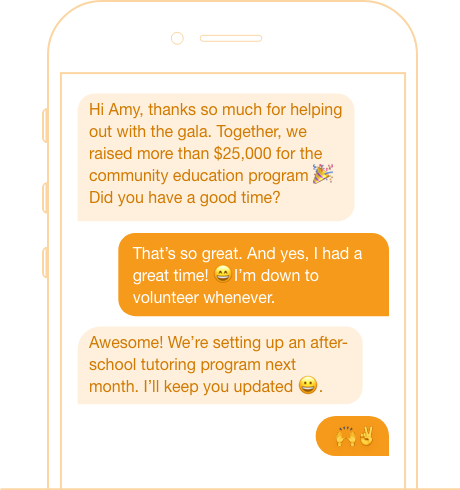
Thanking volunteers via SMS
Thank volunteers and keep them updated.
Let your volunteers know your event’s success, and motivate them to join your next one.
Fundraising
Text messaging lets you have personal conversations with each of your donors, keeping your cause at the top of their minds and encouraging them to lend a hand.
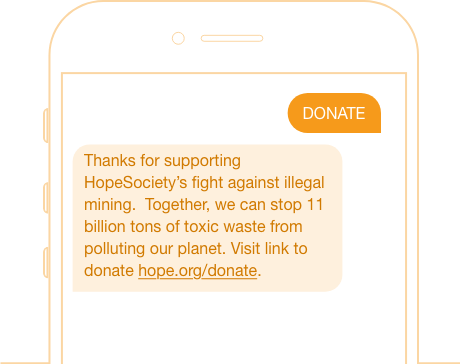
Example of text-to-donate
Let people text to donate.
Let potential donors opt into your text campaigns to receive a donation link.
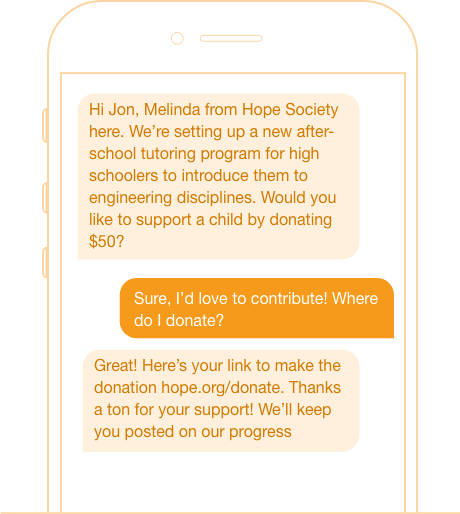
Asking for a donation over an SMS
Ask for donations over a personal conversation.
Inform people about your latest campaign and encourage them to donate over a personal conversation.
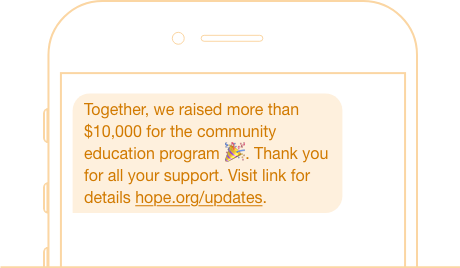
Broadcasting campaign updates via SMS
Broadcast campaign updates.
Send your donors an update whenever you make significant progress in reaching your fundraising goals.
| Take a look at our in-depth article on how you can use text messages for political campaigns |
Get out the vote
Elections are becoming more competitive, and margins razor-thin. This is why Get Out The Vote (GOTV) campaigns are so important. Text messaging helps you reach and mobilize your voters quickly.
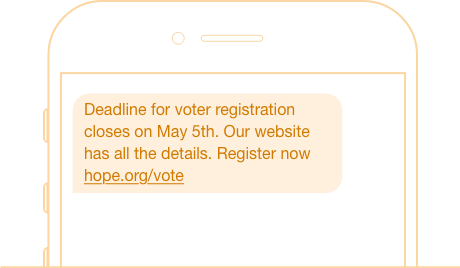
Voter registration reminder text
Voter registration reminder.
Remind your base to register to vote before election day.

Sending polling details via SMS
Help people make a plan to vote.
Inform people about poll timings, and polling location and help them create a plan to vote.
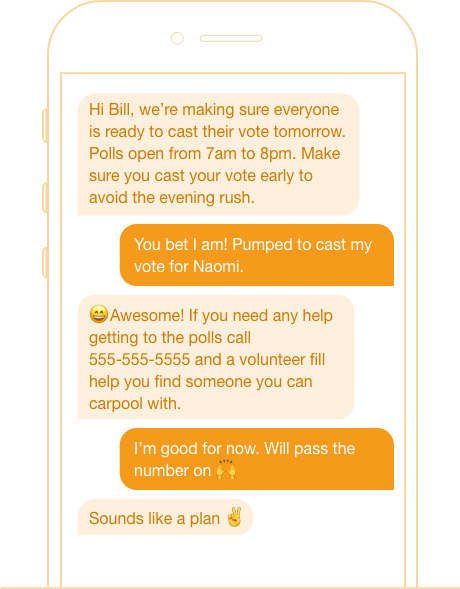
Text reminder to vote
Election day text.
Send a reminder to your base the day before the election to cast their vote.
We’ve covered the use cases in more detail in our guides on using peer to peer texting and our blog where we cover:
- Event promotion
- Fundraising
- Getting out the vote
- Texting for Political Campaigns
- Group texting for Churches
- Texting for Schools
SMS marketing regulations you need to follow
The Telephone Consumer Protection Act (TCPA) is the cornerstone federal law regulating SMS marketing in the United States. It has seen significant updates over the past year that every organization sending texts needs to understand.
The core requirements remain:
- Prior express written consent: You must obtain clear, written consent before sending marketing texts. This consent must be documented and specific to your organization.
- Opt-out mechanism: Recipients must be able to reply with “STOP” (or similar keywords like “QUIT”, “END”, “CANCEL”, or “UNSUBSCRIBE”) to stop receiving messages at any time.
- Time restrictions: Marketing messages should not be sent before 8 a.m. or after 9 p.m. in the recipient’s local time.
- Identification of sender: Every message must clearly identify the sender and provide contact information.
The Opt-Out Rule
As of April 11, 2025, the FCC’s new Opt-Out Rule requires businesses to allow consumers to revoke consent in any reasonable manner – including emails, voicemails, and informal messages like “leave me alone.” Businesses must honor revocation requests within ten days of receipt.
This is a meaningful change from the old standard of only recognizing keywords like “STOP”. Your systems now need to be capable of catching opt-out requests arriving through multiple channels.
After receiving an opt-out request, businesses are permitted to send a single, one-time confirmation text clarifying the scope of the consumer’s revocation. This clarification message must not contain any marketing or promotional content, and must be sent within five minutes of receiving the request.
Penalties for non-compliance
TCPA violations carry fines ranging from$500 to $1,500 per violation, per class member, with no requirement to prove actual injury – making class-action exposure significant for organizations that get this wrong.
| Note: Always consult a legal professional to ensure you’re fully compliant with current TCPA requirements. The regulatory landscape is actively evolving.Read Also: Telephone Consumer Protection Act (TCPA) Compliance – All the Latest Updates |
State-Level “Mini-TCPA” Laws (USA)
The TCPA sets the federal floor, but several US states have passed their own stricter SMS marketing regulations that apply on top of federal rules. States, including California, Florida, and Washington, have enacted laws with requirements that go beyond the federal TCPA. Most notably, Texas Senate Bill 140 (SB 140), which took effect September 1, 2025, significantly expanded Texas’s telemarketing regulations to cover marketing by text message.
If your organization is texting supporters, donors, or voters in multiple states, federal TCPA compliance alone is not sufficient. Check the specific requirements for each state where you are actively texting, or work with a legal advisor who specializes in telemarketing compliance.
Read Also: SMS Compliance TCPA: How to Stay Fully Compliant
Spam Act (Australia)
In Australia, the Spam Act regulates the sending of unsolicited commercial electronic messages, including SMS.
- Consent: Senders must obtain the recipient’s consent before sending commercial electronic messages. Consent can be express or inferred, but it must be clear and documented.
- Identifiable sender: Messages must contain accurate information about the sender’s identity, including name and contact information.
- Unsubscribe mechanism: Messages must include a functional and clear opt-out mechanism, at no cost to the recipient.
- Time restrictions: Messages should be sent during normal business hours.
- Educational material: The Spam Act provides some exemptions for educational, factual, or informational material, as well as messages from registered charities.
| Note: The Spam Act applies to electronic messages sent to, from, or within Australia, regardless of where the sender is located. |
PECR (UK)
The Privacy and Electronic Communications Regulations (PECR) govern the use of electronic communications in the United Kingdom, including SMS.
- Consent for marketing communications: Individuals must give clear, informed, and freely given consent before receiving direct marketing SMS.
- Opt-out mechanism: Text messages must include a clear and simple opt-out mechanism, free of charge.
- Identification of sender: Text messages must clearly identify the sender and provide contact information.
- Time restrictions: Messages should not be sent very early in the morning or late at night.
- Exemptions for existing customers: PECR allows businesses to send marketing messages to existing customers without explicit consent, provided the messages relate to similar products or services, and customers had the option to opt out at the time of data collection.
| Note: This is not an exhaustive list, and the regulatory landscape is subject to change. Always consult legal professionals or regulatory authorities to ensure compliance with the latest regulations in your specific context. |
Best practices for SMS marketing
“With great power…” Well, you know the rest.
With tools like SMS marketing at your disposal, you can push a message to thousands of people with a click. That means you need to be extra mindful of how you reach out to your contacts.
Get permission first
It’s polite to only send text messages to people who have permitted you to do so. There are two good reasons to get SMS opt-ins.
- You want to ensure you comply with regulations for your region, which in most cases involves getting an opt-in from consumers.
- You don’t want to annoy your prospects by sending them an unsolicited SMS message.
Ask your users to opt into your texts by showing them how your texts can provide value. Entice them with new updates, offers, or other useful information.

Don’t leave your conversations hanging
Text messaging offers you the opportunity to make a personal connection with the people at the other end. A big part of that is having a conversation with them.
If you have agents sending texts to people, remember that they may not always respond to every conversation. Keep track of pending conversations and reassign them to active agents.
Most SMS marketing tools, especially reputable SMS marketing most platforms, have this feature built in to make the process easier.
Don’t leave them hanging if people have a question they need you to answer or want to tell you how much they love your brand or organization.

Be concise and conversational
A rambling text will quickly lose a reader’s attention, while one that is too short won’t get your message across. You’re good to go as long as your texts let the receiver identify you and understand what you want them to do. Avoid SMS shorthand or corporate jargon unless you’re talking to a specific audience that’s likely to understand it.
Don’t abuse the privilege
It takes a certain amount of trust for someone to give out their contact details to your organization and opt-in to your text communications. Maintain and respect that trust and comply with regulations by ensuring they get only what they have agreed to, i.e., the content and frequency of your texts.
Moreover, respecting the preferences of the receiver will lead to better results for your organization.

Make opting out simple
Let’s face it, some people don’t want your texts.
When you receive an opt-out request (“STOP”, “UNSUBSCRIBE”, “remove me from your list”, etc.), it’s important to honor the request promptly. Make sure your subscribers know they can opt-out of your communications any time they like, and tell them how.
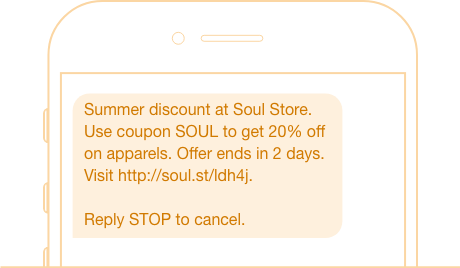
Opt-out option in a text
Use clear language
The language you use should match the goal of your message. If you want to convey information or prompt a specific action, phrase your texts as clear statements. If you want to start a dialogue, frame your message as a conversation opener and be ready to respond. While appearing friendly is essential, don’t frame your mass texts as conversations if you’re not going to be around to reply.
What to look for in an SMS marketing tool
There are plenty of SMS marketing tools out there, but the best ones all have a few things in common. They provide an array of features you can use to make your organizations text messaging easier and better.
Displaying an alphanumeric sender ID
Alphanumeric Sender IDs lets you set your company name or brand as the Sender ID when you send a one-way SMS message to prospects.
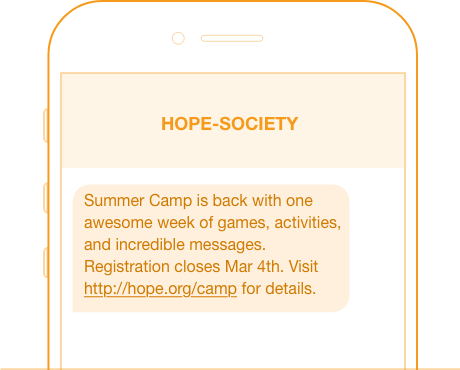
Displaying alphanumeric sender ID
Choose an SMS marketing platform that makes it quick and easy for you to activate your custom sender ID and start using it in your text messaging campaigns.
Note: Some countries require that you register your alphanumeric Sender ID beforehand. Others don’t support the feature.
Short codes and long codes for your campaigns
Your SMS marketing platform should make it simple for you to lease and start using short codes and long codes for your SMS campaign and help you stay compliant while using them.
Read next: Shortcode Texting: Everything You Need To Know In 2026
In-depth reporting
Keeping an eye on how your text message marketing campaigns are doing is important so you can adjust your strategies when needed.
Ensure you can pull up statistics on sent texts, response rates, and up-to-date contact counts. You should also be able to keep track of your opt-ins and opt-outs, letting you see when and how new contacts are joining or leaving your text message marketing campaigns.
Read next: SMS Campaigns Analytics and Reporting: How to Measure the Performance of Campaigns on CallHub
Sending automatic replies
Setting up a single ‘Thank you’ response to an opt-in is pretty basic. Your tool should let you go above and beyond that by automatically collecting more information from opt-ins when needed (name, email, etc.).
You should also be able to set up automatic responses to your mass texts (For example, when someone texts “RSVP”, you can send them a “Thank you”.)
Read Also: Proven Auto Reply Messages Sample That Deliver Results
Ability to assign conversations to agents
For big campaigns where you want to engage people in conversations, it is not feasible for one person to manage every single conversation. If your campaigns will involve many back-and-forth conversations, your SMS tool should have peer-to-peer texting functionality.
This means that it allows you to assign batches of contacts to agents who then carry out conversations with the assigned batch.
Integrations that connect your tools
Integrations come in all forms and sizes. Most often, integration means you can pull lists from your CRM into the SMS tool at the click of a button.
Beyond that, some tools let you send new mobile subscribers directly to your CRM, update event registrations, sync surveys, start an email nurturing campaign, and more. Integrations save you a ton of time and let you set up multiple workflows (e.g., start email nurturing if the email is collected from a new mobile subscriber).
If you can’t find a custom integration, ensure your SMS tool integrates with Zapier. Zapier lets you combine multiple tools to get things done – very much like a custom integration, but with one additional step.
That’s almost everything you need to get started with SMS marketing.
If you’d instead try any or all of this out, take CallHub for a test run by creating a free account.
FAQs on sms marketing
Why is SMS marketing effective for nonprofits, campaigns, and small businesses?
SMS marketing is highly effective because text messages have high open and response rates—often above 90%. Messages are delivered instantly, making it ideal for urgent updates, event reminders, fundraising, and mobilizing supporters or customers.
What are the main types of SMS marketing campaigns?
The three main types are:
- Conversational (two-way engagement, feedback, support)
- Promotional (offers, sales, announcements)
- Transactional (order confirmations, reminders)
How do I build a compliant SMS marketing list?
To build a compliant list, ask people to opt in by texting a keyword to your number or filling out a form. Always get clear consent, explain what they’ll receive, and provide an easy way to opt out.
What’s the difference between a short code, shared short code, long code, and 10DLC?
- Short code: 5-6 digit number for high-volume, one-way messages
- Shared short code: Multiple organizations share the same code (less common now)
- Long code: Standard 10-digit number, good for two-way conversations
- 10DLC: Registered long code for higher throughput and compliance in the US
What regulations must I follow for SMS marketing in the US?
You must comply with the Telephone Consumer Protection Act (TCPA):
- Clearly identify your organization
- Get express written consent before sending marketing texts
- Include opt-out instructions
- Don’t send messages before 8 a.m. or after 9 p.m. local time